.png)
When Nate Poole doesn’t like something I’ve sent him, I know about it fast. He’ll fire off a message that’s direct, unfiltered, usually funny, telling me exactly what was missed. Plenty of people would find that intimidating, but I’ve come to see it as the best thing about working with him.
I’m Colleen Stackpole, a Customer Success Engineer at AirWorks. For the better part of six years, Nate, Survey CAD Manager and Reality Capture Lead at Spalding DeDecker Associates (SDA) in Rochester Hills, Michigan, has been one of my customers, and somewhere along the way he became one of my favorite people to work with. This is the story of how a survey-first firm and an AI mapping company built something that actually works, told from my side of the order screen.
If you met Nate, you might not guess he’s the person quietly running CAD and reality capture for one of Michigan’s oldest and most trusted survey firms. His wife, their five kids, and himself, live out on a dirt road next to a little no-motor lake he more or less treats as his own. He does his best thinking, by his own account, in a hoodie and a T-shirt. Comfort is the key ingredient to his never-ending list of new ideas and problems to solve. In his free time, he 3D prints creations to make his life easier, like a tunnel connecting two brooders for his new chicks.
In high school, Nate wanted to design cars right up until a guidance counselor showed him a drawing full of contour lines and pointed him toward a co-op at a civil engineering firm within walking distance. He never looked back. That restless, tinkerer’s instinct, always trying the next piece of software, always asking how to get more out of a tool, is exactly what makes him such a good partner.
.png)
Six Years in the Making
SDA first found AirWorks back in 2020, before either of us had much experience with LiDAR. They ran an early trial, and then things went stale. They were between drone pilots, and their drone project volume was low. A couple of years later, once we’d started leading with LiDAR-based extraction and expanding our layer offerings, and once SDA had built up its own collection capability, the partnership reignited. Nate’s first point of contact at AirWorks began with a member of the sales team. By the time the relationship really hit its stride, I’d taken over the account as his dedicated Customer Success Engineer. We’ve been building on it ever since.
“Your product is really good and more people need to know about it.”
— Nate Poole, Spalding DeDecker Associates
Why We Click
Part of why Nate and I work so well together is that we come from oddly parallel places. We both got our start through co-ops. I came to AirWorks as a sophomore co-op and ended up back here full-time, and Nate’s whole career began with that high-school co-op at the civil firm down the road. He’s such a believer in them that he’s been pushing SDA to partner with local schools and bring co-op students in.
And then there’s the design background. I earned my bachelor’s and master’s in architecture from Wentworth Institute of Technology before I made the transition to CAD and GIS engineer, then to Customer Success Engineer at AirWorks. Despite not having a degree in architecture, Nate lives in that AEC design world every day. So, when Nate explains what his drafters need, I get it, and I don’t just mean the file format, but the design intent behind it. That shared language saves us both a lot of time.
What Nate’s Team Is Up Against
SDA is a survey-first firm, with survey being their biggest group, and “field to finish” is how Nate describes what they do. But like a lot of AEC firms, their drafting department is lean, around five or six people. So, when six projects land at once and every client wants their deliverable in a matter of months, the math stops working. The pressure comes from two directions at the same time: internally, from time and management, and externally, from clients who’ve come to expect survey-grade accuracy on a timeline traditional fielding simply can’t support.
Here’s the thing I always come back to with Nate: In his own words, "AirWorks doesn’t necessarily replace the drafting side of it. It replaces the field side of it." By taking the time constraints of traditional surveying out of the equation, his drafters can pull an AirWorks deliverable straight into their CAD software, customized to SDA’s own template, and start designing immediately. No more waiting on a survey crew for topography, no more building basemaps from scratch.
One of Nate’s favorite things about working with us is that he can take exactly what he wants and leave the rest. “The other places are typically all or nothing,” he told me. Being able to tailor a package means his team can keep the pieces they’d rather QC in house, like surfaces, while ordering everything else from us, so the work comes together side by side.
The Project That Tested It: Maconce Elementary
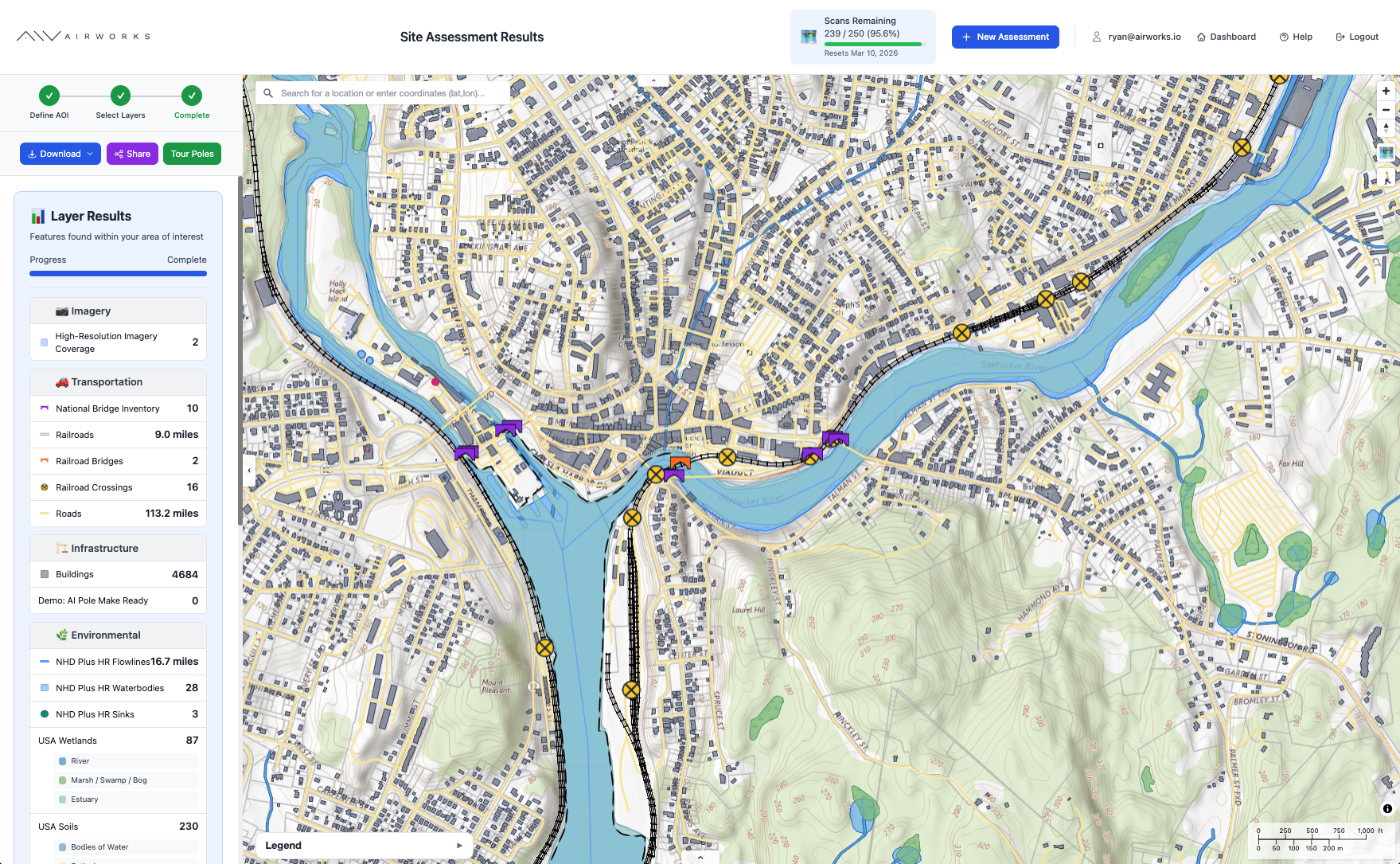
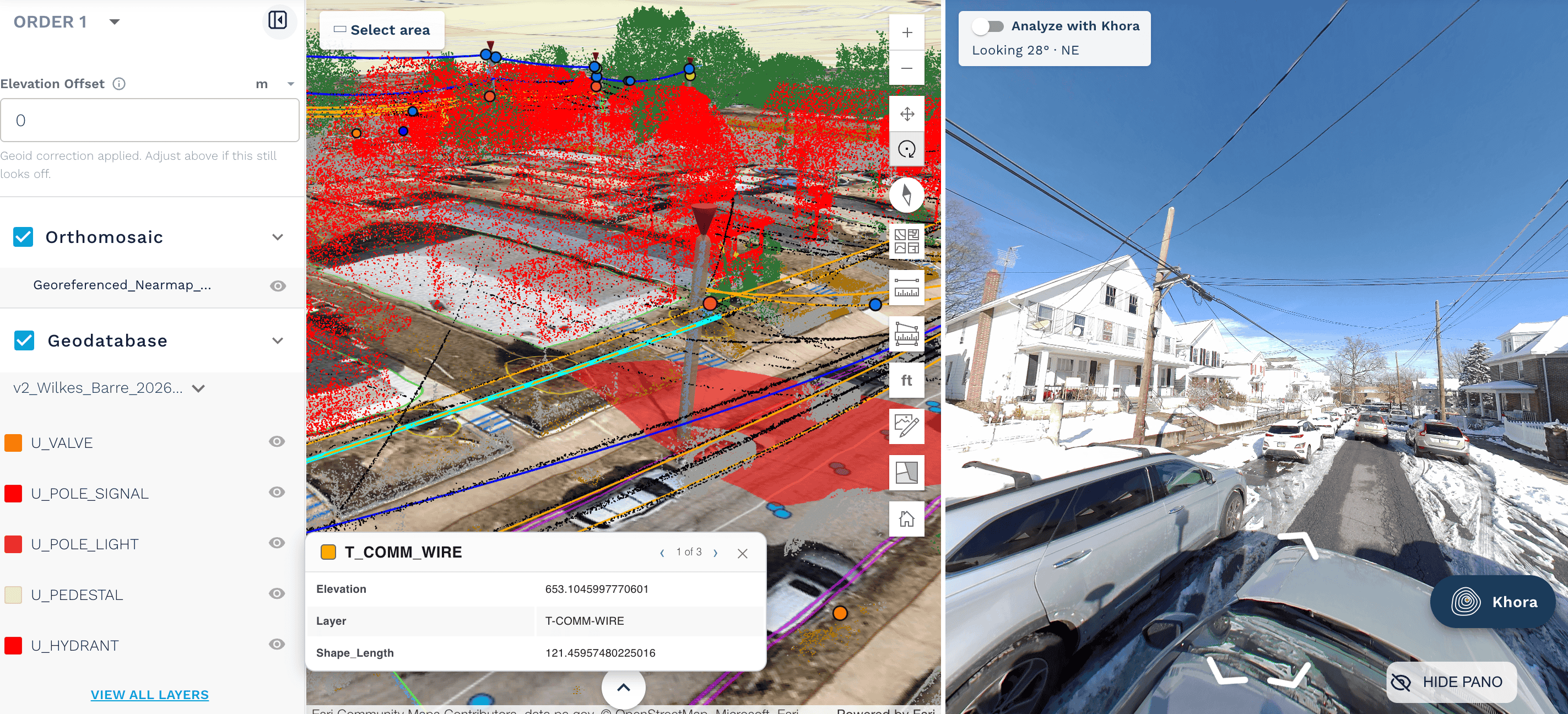
The project that really shows how Nate and I work together was a recent existing-conditions survey in St. Clair County, Michigan, for Maconce Elementary School. It was a pretty typical 3D vector project for SDA’s land development group. They collected the LiDAR in house and uploaded the LAZ and ortho files to our app, and we turned around a full deliverable for the nearly 20-acre site including: 3D linework for buildings, roads, curbs, sidewalks, and utilities, plus topography and an XML surface, in 11 business days.
And then Nate told me what was missing.
This is the part I most want people to understand about our partnership. He didn’t sit quietly on the deliverable, unhappy with the results, and he didn’t go vent to his team. He reached out to me directly and walked me through the “misses.” When we dug in together, the real issue wasn’t the extraction, it was a lack of clarity in the order experience. Nate had assumed the 3D vector package was the best fit for his team, so he’d never explored the other options, which meant he wasn’t aware of the full capabilities we have to offer. The same gap showed up in the details: he’d ordered an XML surface when what he really wanted were breaklines, and he hadn’t been able to see or select all the layers he had access to.
What We Built Together
Because Nate brought that feedback straight to me, we were able to sit down and build a custom package with all the layers he actually wants, scoped and priced to match how his team really works. A block template is next on our list, so AirWorks deliverables already matched SDA’s own blocks. And we’ve sorted out smaller things too, like sending breaklines instead of the dense XML surface he doesn’t need.
This is the whole idea behind the customer success engineer model at AirWorks: every customer is paired with a dedicated CSE from the operations team, someone technical who makes sure deliveries go smoothly, and that feedback actually turns into changes. For Nate and the SDA team, that’s me. I’ve been here four years, from co-op to full-time, and between my architecture background and the fact that I’m one of the people who QCs these projects directly, I’d like to think I’m a pretty good match for an AEC customer like Nate.
And for the record, it goes both ways. I point things out on my end too. On one of his recent projects, the quality of the ortho was a much lower resolution than I’m used to seeing from Nate. It threw me off a little bit and I had to double check that I was looking at the right project. We sorted it out with a bit of good-natured back and forth. That’s what a genuine, two-way relationship looks like: nobody’s performing, everybody’s just trying to get it right.
Where We Go From Here
Nate’s already looking at what’s next; overhead utility corridors, telecom work, maybe even interior floor plans someday. His instinct is always to wring every last bit of value out of a tool, and I love that, because it pushes us to be better too. Six years in, what started as a quiet trial has become one of the partnerships I’m proudest of. I’ll keep listening, he’ll keep telling me exactly what he thinks, and together we’ll keep bringing the field to SDA, faster every time.

.png)
.png)